Insights / Convergence
ConvergenceSolar powered data center UAE guide: how far can solar and storage carry an AI load?
· 9 min read
On this page
A solar powered data center UAE project joins two fast-growing markets: AI computing and Gulf solar. AI data centres need large amounts of steady power. The Gulf has some of the best solar resource in the world. The question is how far solar and storage can carry a load that never sleeps.
This guide sets out what the numbers show. It uses hourly solar data for Dubai, recent IEA analysis and projects already running in the UAE. A calculator lets you test your own scenario.
Why are AI data centres looking at solar and storage?
Data centre power demand is rising fast. The IEA estimates data centres used about 415 TWh in 2024, around 1.5% of the world’s electricity. Its 2026 update puts use at 485 TWh in 2025 and about 950 TWh by 2030, around 3% of global demand. Power use at AI-focused data centres is set to triple over the same period.
Individual sites are large. The IEA says a typical AI-focused data centre uses as much electricity as 100,000 households. The largest ones under construction will use 20 times as much.
That demand is pushing operators to find new supply quickly. The IEA reports that tech companies signed around 40% of corporate renewable power purchase agreements in 2025. It also says on-site battery storage is becoming a critical technology for the next generation of AI data centres.
What makes the UAE different?
The UAE is building AI capacity at scale. The planned UAE-US AI campus in Abu Dhabi will include 5 GW of capacity for AI data centres, powered by nuclear, solar and gas.
It already has large solar-and-storage experience. Abu Dhabi has broken ground on a project pairing 5.2 GW of solar with 19 GWh of batteries, designed to supply 1 GW of round-the-clock power by 2027. Dubai’s DEWA runs a green data centre at the Mohammed bin Rashid Al Maktoum Solar Park, powered by solar energy from the park.
How much of a data centre load can solar and storage cover?
Try your own numbers below. Set the site load, the solar array, the battery and the solar yield for your location. The gauge shows the share of annual demand met by solar, and the bar shows how the rest is supplied.
Interactive estimate
Solar + storage scenario for a data centre
Solar fraction 56%; curtailed 0.0 GWh
Annual load
876.0 GWh
Solar output
508.8 GWh
Curtailed solar
0.0 GWh
- Solar, direct: 365.0 GWh
- Solar via battery: 122.2 GWh
- Grid or other supply: 388.8 GWh
Assumptions
- The data centre load is flat, 24 hours a day, 365 days a year. Real AI sites vary with utilisation and cooling load.
- Solar serves the load directly for up to 10 hours a day. We calibrated this against hourly PVGIS-SARAH3 data for Dubai (2019–2023): an array five to ten times the load meets only about 40% (fixed tilt) to 43% (single-axis tracker) of a flat load directly.
- Surplus solar charges the battery, which cycles once a day at up to its usable MWh and returns it at 85% round-trip efficiency (NREL/NLR Annual Technology Baseline 2025). Anything else is curtailed. The battery cannot supply more than the night-time need.
- Location presets use PVGIS 5.3 specific yields (fixed optimum tilt, 14% losses) and PVGIS single-axis tracker gains for each city. The slider lets you enter your own value.
- This is an annual energy balance, not an hourly dispatch model. Checked against the hourly Dubai data, it overstates the solar fraction by up to about 6 percentage points at 2–3 MWp per MW of load, and understates it by up to about 5 points for very large arrays (8–10 MWp per MW) with large batteries. It ignores seasonal and dusty-day shortfalls, degradation, grid export and backup generation.
Indicative estimate only. Contact us for an engineered proposal.
The default case is a 100 MW load with 250 MWp of tracking solar and 400 MWh of usable storage in Dubai. The model puts the solar fraction at about 56%. Our hourly check for the same case gives about 53%, so treat the calculator as a first estimate.
Why can’t solar alone cover more?
A data centre draws power all day and all night. Solar produces only in daylight, and output peaks around midday. Once the array covers the daytime load, any extra solar is surplus unless you can store or export it.
We tested this with five years of hourly PVGIS data for Dubai, from 2019 to 2023, and a flat load. These are the results:
| Solar per MW of load | Battery per MW of load | Fixed tilt | Single-axis tracker |
|---|---|---|---|
| 1 MWp | none | 20% | 23% |
| 3 MWp | none | 37% | 41% |
| 5 MWp | none | 40% | 42% |
| 3 MWp | 8 MWh | 56% | 64% |
| 4 MWp | 12 MWh | 73% | 81% |
| 5.2 MWp | 19 MWh | 92% | 95% |
Without storage, going from 3 to 5 MWp per MW adds only a few points. The extra energy arrives at midday, when the load is already covered. Storage is what unlocks higher solar fractions.
The last row matches the ratio of Abu Dhabi’s round-the-clock project: 5.2 GW of solar and 19 GWh of storage for 1 GW of supply. Even at that scale, cloudy and dusty days leave a gap for the grid or other supply.
How should you size the battery for a data centre?
Size the battery for the job it does. A data centre may need storage for three different jobs:
- Solar shifting: store midday surplus and release it in the evening and night. This battery cycles every day, and its size sets the solar fraction.
- Ride-through: the UPS bridges the seconds to minutes until backup generation or the grid returns. This is sized for power, not daily energy.
- Grid support: cap peak demand or respond to grid signals. The IEA expects 20–25 GW of battery storage could be installed in data centres worldwide by 2030.
For solar shifting, the calculator treats battery size as usable energy, cycled once a day. It returns stored energy at 85% round-trip efficiency, the figure NREL’s Annual Technology Baseline uses for commercial storage. Nameplate size must be larger to allow for depth of discharge.
Our guide to C&I battery storage sizing in the GCC explains how to go from usable to nameplate energy. For chemistry, see why LFP dominates energy storage. Heat, safety and cycle life all favour LFP for a daily-cycling battery in the Gulf.
Where should the solar go?
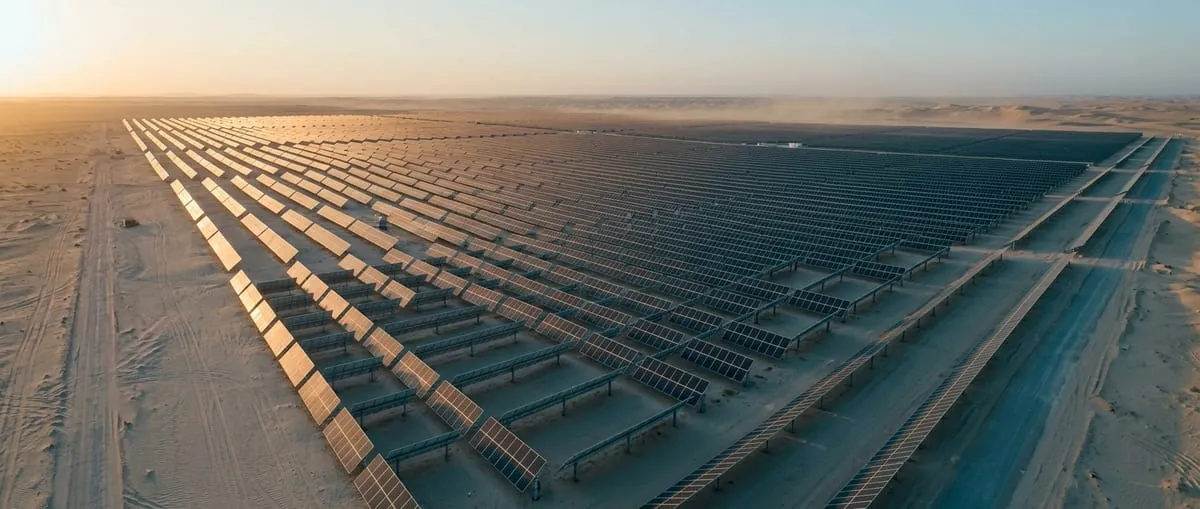
Land is the first constraint. Abu Dhabi’s Al Dhafra plant fits 2.1 GWp of tracking solar on just over 20 km². That is roughly 1 km² for every 100 MWp. A 100 MW data centre with 250 MWp of solar would need a few square kilometres of land.
That leaves three common layouts:
- On-site solar: rooftops, car parks and nearby land. This rarely covers more than a small share of a large site’s load, but it cuts daytime grid demand.
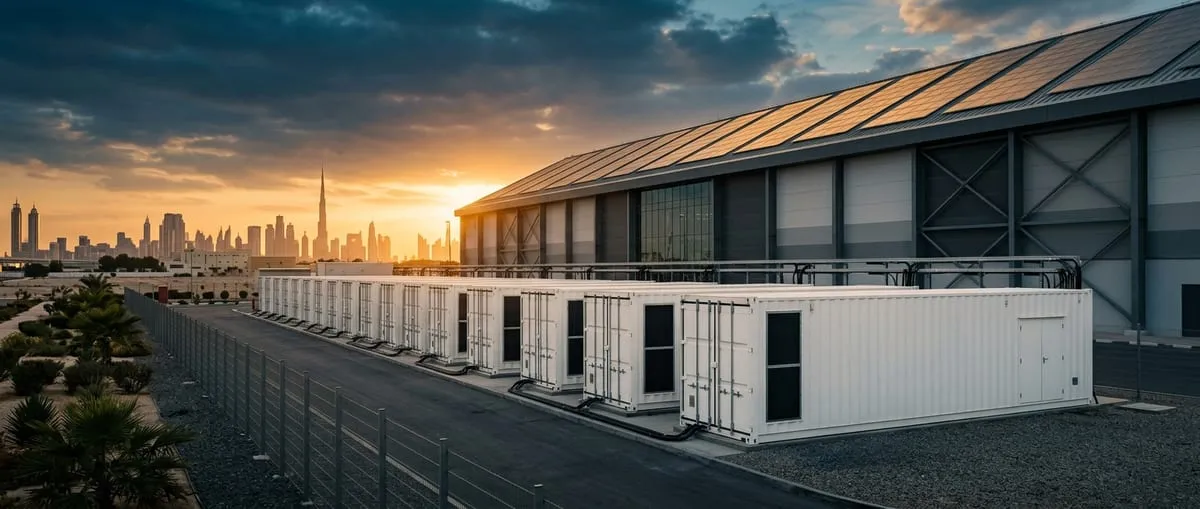
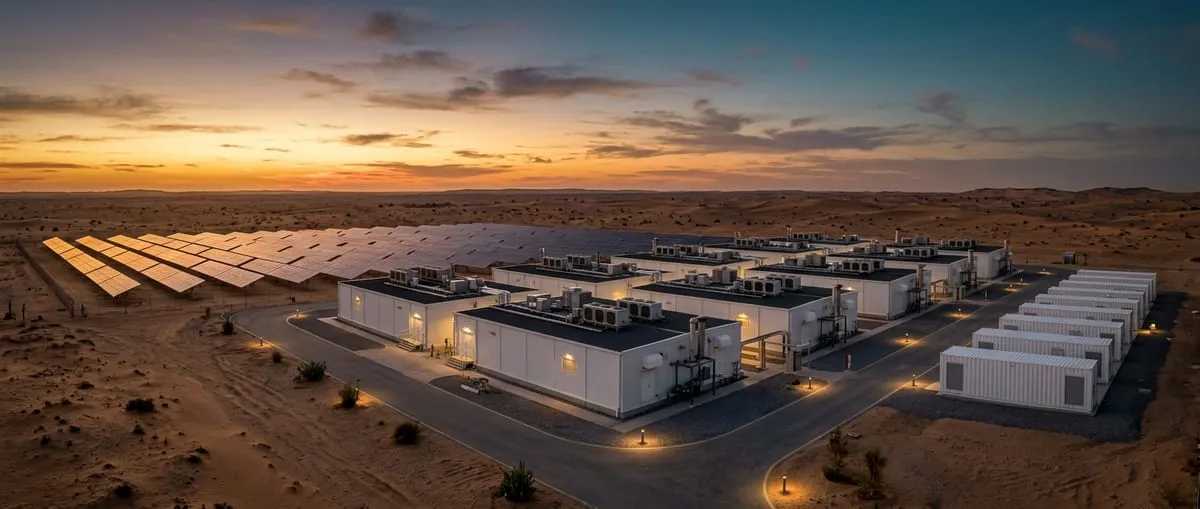
- Adjacent solar and storage: a dedicated plant next to the campus, with a private connection. This suits new builds on open desert land.
- Off-site supply: a solar plant elsewhere, supplied through the grid under a utility green tariff or power purchase agreement. This is how most large operators buy renewable energy today.
For a new desert build, trackers raise yield per MWp by about 18% in Dubai. Our guide to single-axis trackers in the desert covers soiling, wind and maintenance. For inverter choice at this scale, see string vs central vs hybrid inverters.
What does a solar powered data center UAE project look like today?
Two public examples show the range. DEWA’s green data centre sits inside the Mohammed bin Rashid Al Maktoum Solar Park. It is planned to reach 100 MW in 10 phases, across 100,000 m². DEWA says the first phase holds the Guinness World Record as the world’s largest solar-powered data centre.
At much larger scale, the UAE-US AI campus in Abu Dhabi plans 5 GW of AI data centre capacity. It will use a mix of nuclear, solar and gas rather than solar alone. That matches what the hourly numbers show: solar can carry a large share of a data centre’s energy, but firm supply fills the gaps.
What does it mean for carbon?
Every megawatt-hour from solar replaces grid electricity. Ember data put the UAE grid at about 0.468 kg CO₂e per kWh in 2024. A 100 MW data centre uses about 876 GWh a year, so each 10% of solar fraction avoids roughly 41,000 tonnes of CO₂e a year.
What about cooling, power quality and uptime?
Solar and storage change where energy comes from. They do not change what the IT load needs. That still means clean, uninterrupted power and enough cooling for dense racks.
Cooling adds to the load. Uptime Institute’s 2025 survey puts the global average annual PUE at 1.54, meaning facility overhead adds 54% on top of the IT load. Uptime notes that climate limits cooling choices and that the best figures come from cool, high-latitude sites, so hot climates such as the Gulf typically run higher. Include cooling in the load you enter in the calculator, not just the servers.
Uptime also finds power issues are still the top cause of impactful outages. Keep the UPS, switchgear and backup generation designed to the site’s uptime target, whatever the solar fraction.
AI racks also run far denser than traditional servers. See our guide to GPU rack power and cooling and our comparison of direct-to-chip vs immersion cooling. Our cooling and power range covers liquid cooling, UPS and PDUs for AI racks.
How does this apply to private AI on your own premises?
Not every AI deployment is a hyperscale campus. Many organisations in the Gulf run private AI on their own premises, to keep sensitive data in-house. A server room with a few GPU racks draws far less than a campus. Uptime finds most operators’ highest-density racks still peak below 30 kW.
At that scale, the same logic applies in miniature. Rooftop solar can trim the room’s daytime demand. A battery can shift some of that solar into the evening and add resilience. Size both from your measured load, including cooling.
Our private AI solutions and private AI bundles include the site assessment for power and cooling. For the business case, see our comparison of on-premise vs cloud AI costs. Synapse Horizon supplies both halves: see our energy hub for solar and storage and our AI infrastructure hub for compute, cooling and power.
Key takeaways
- Hourly PVGIS data for Dubai show solar alone can meet only about 40–43% of a flat 24/7 load, however large the array.
- Storage lifts the solar fraction. With trackers, 4 MWp and 12 MWh per MW covered about 81% of demand, and 5.2 MWp with 19 MWh about 95%.
- Land is a real limit: roughly 1 km² per 100 MWp of tracking solar, so large sites rely on adjacent or off-site plants.
- Include cooling in the load. The 2025 global average PUE was 1.54, and hot climates such as the Gulf typically run higher.
- Keep UPS, switchgear and backup sized to the uptime target, whatever the solar fraction.
Frequently asked questions
Can a data centre in the UAE run fully on solar power?
How much battery storage does a solar-powered data centre need?
How much land does solar for a data centre need?
Do data centres in the UAE already use solar?
Why use batteries at a data centre that already has a UPS?
Sources
- International Energy Agency –Energy and AI: Executive summary
- International Energy Agency –Key Questions on Energy and AI: Executive summary
- International Energy Agency –Data centre electricity use surged in 2025, even with tightening bottlenecks driving a scramble for solutions
- European Commission Joint Research Centre –PVGIS 5.3 hourly radiation and PV output (seriescalc, PVGIS-SARAH3, 2019–2023)
- Embassy of the United Arab Emirates, Washington DC –UAE and US Presidents attend unveiling of Phase 1 of new 5GW AI campus in Abu Dhabi
- Dubai Electricity and Water Authority (DEWA) –Maktoum bin Mohammed inaugurates second phase of green data centre
- Abu Dhabi Media Office –Groundbreaking of world's 1st gigascale round-the-clock renewable energy project
- National Renewable Energy Laboratory (NREL/NLR) –Annual Technology Baseline 2025: Commercial Battery Storage
- Uptime Institute –Uptime Institute Global Data Center Survey 2025
- Climate Bonds Initiative –Al Dhafrah Solar PV2 achieves Climate Bonds Certification
- Our World in Data, based on Ember –Carbon intensity of electricity generation