Insights / Private AI
Private AIDirect to chip vs immersion cooling: which suits your AI racks?
· 9 min read
On this page
The choice of direct to chip vs immersion cooling now comes up early in any AI hardware project. GPU servers draw far more power than the servers most rooms were built for, and nearly all of that power becomes heat.
This guide compares the two main liquid methods. It also covers the two air-based options they replace or extend: room air and rear-door heat exchangers. A weighted tool lets you rank all four against your own priorities.
Why do AI racks need liquid cooling at all?
Most data-centre racks still run at modest power. Uptime Institute’s 2025 survey puts the average typical rack at almost 9 kW, or 7.5 kW without the densest sites. Few facilities have any racks above 30 kW.
AI racks are different. Uptime Institute notes that AI training racks already pass 40 kW, and some newer systems exceed 100 kW. Our guide to GPU rack power density and cooling shows how quickly a few GPU servers add up.
Air struggles at these levels. Uptime Institute puts room (perimeter) air cooling at up to 20–25 kW per rack with optimised airflow, or 10–15 kW in older systems. Beyond that, the room cannot move enough air.
Fans are part of the problem. ASHRAE’s liquid cooling white paper says server fans can take 10% to 20% of server power in some dense systems. In a 50 kW rack, that is at least 5 kW spent just moving air.
How do the four cooling methods compare?
Each method moves heat away from the chip in a different way. The table below sums up how far each one goes.
| Method | How it works | Density |
|---|---|---|
| Room air | Fans push heat into hot aisles; room units cool the air | Up to 20–25 kW per rack |
| Rear-door heat exchanger | A water coil on the rack door cools exhaust air | Up to about 50 kW per rack (close-coupled) |
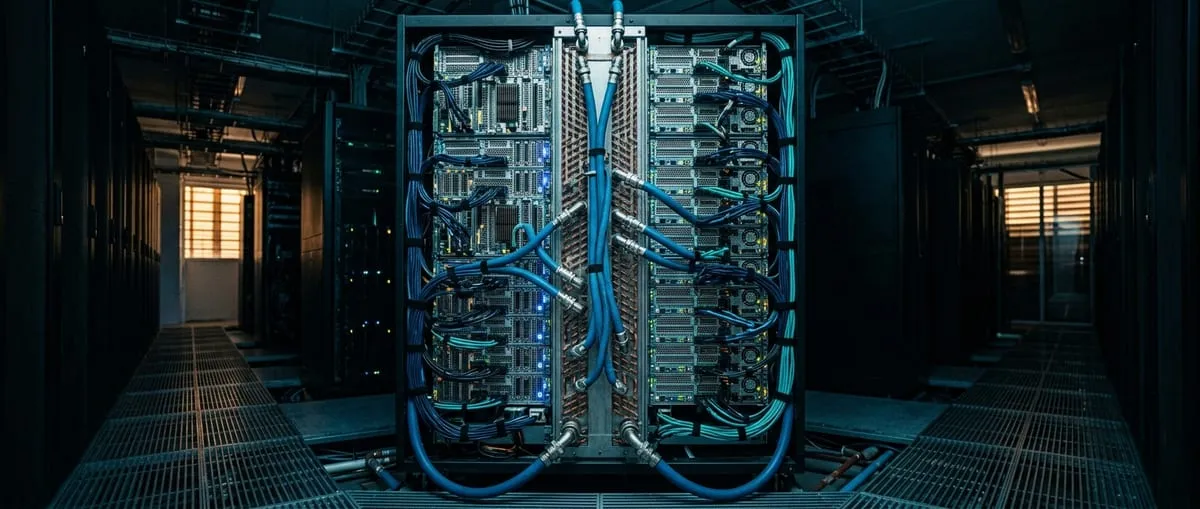
| Direct-to-chip | Cold plates on GPUs and CPUs carry heat away in liquid | Over 150 kW per rack |
| Immersion | Whole servers sit in a tank of dielectric fluid | Over 150 kW per tank; two-phase tanks 500 kW+ |
Density figures come from Uptime Institute, except the two-phase figure, which comes from the Nature study. Use the tool below to weight the six criteria that matter most at your site.
Interactive estimate
Cooling method comparison: weight what matters to you
kW per rack the method can remove. 0 = ignore, 5 = critical.
Cooling energy and PUE. 0 = ignore, 5 = critical.
Fit into an existing air-cooled room. 0 = ignore, 5 = critical.
Servicing servers and the cooling loop. 0 = ignore, 5 = critical.
Site and grid water consumption. 0 = ignore, 5 = critical.
Equipment added to the room. 0 = ignore, 5 = critical.
Top ranked: Rear-door heat exchanger, 70 out of 100.
- 1. Rear-door heat exchanger70
Pros and cons
Pros
- Fits onto existing racks; suits new and retrofit rooms (US DOE FEMP).
- Passive doors have no moving parts and need little maintenance.
Cons
- Close-coupled cooling typically tops out near 50 kW per rack (Uptime Institute).
- Brings water to the rack, so it needs leak detection and water-side care.
- 2. Direct-to-chip liquid70
Pros and cons
Pros
- Cold plates can support racks above 150 kW (Uptime Institute).
- Deploys with less disruption to air-cooled halls than immersion (Nature, 2025).
Cons
- Cold plates capture about 50–80% or more of the heat; the rest still needs air (Nature, 2025).
- Needs CDUs, manifolds, water-quality control and a clean-and-flush plan (ASHRAE TC 9.9).
- 3. Air (hot/cold aisle)67
Pros and cons
Pros
- No new plumbing: works in any existing data room.
- Servers are serviced in the usual way.
Cons
- About 20–25 kW per rack with optimised airflow, or 10–15 kW in older rooms (Uptime Institute).
- Server fans and chillers use more energy than liquid options.
- 4. Immersion (single/two-phase)67
Pros and cons
Pros
- Fluid absorbs all server heat; two-phase tanks can exceed 500 kW (Nature, 2025).
- Largest cuts in water use in the Nature life-cycle study: 45–48% vs air on US grid power (80–82% on renewable power).
Cons
- Servicing can need a crane or two-person lift (ASHRAE TC 9.9).
- Fluid compatibility and warranty checks; two-phase fluids face PFAS rules.
Assumptions
- Each method is scored 1 (worst) to 5 (best) on six criteria. The score shown is the weighted average as a percentage of a perfect 5 on every criterion.
- Density: Uptime Institute (2025) puts perimeter air at 20–25 kW per rack, close-coupled cooling such as rear doors at up to about 50 kW, cold plates above 150 kW per rack and immersion above 150 kW per tank. Two-phase immersion can reach 500 kW or more per tank (Alissa et al., Nature, 2025).
- Efficiency and water: against air cooling, the Nature 2025 life-cycle study found energy savings of 15% (cold plate), 15% (one-phase immersion) and 20% (two-phase), and blue-water savings of 31%, 45% and 48%, on average US grid electricity. With 100% renewable power, the water savings were 50%, 80% and 82%. Rear doors run on warmer water and can cut chiller use (US DOE FEMP bulletin).
- Retrofit and maintenance draw on the US DOE FEMP rear-door bulletin, ASHRAE TC 9.9 (2021) and the Nature study.
- Up-front cost is our own ranking by the equipment each method adds to an air-cooled room. No prices are used.
- Scores are relative and generic. A site survey decides the right method for your racks.
Indicative estimate only. Contact us for an engineered proposal.
With equal weights, the four options land close together. Rear doors and direct-to-chip score 70, air and immersion 67. That is the point: the answer depends on what you value.
Choose the “Existing server room” preset, which stresses retrofit, upkeep and cost. Air ranks first at 79, then rear doors at 74, direct-to-chip at 66 and immersion at 54. The “New high-density AI hall” preset reverses the order. Immersion leads at 82, then direct-to-chip at 74, rear doors at 66 and air at 51.
What is direct-to-chip cooling?
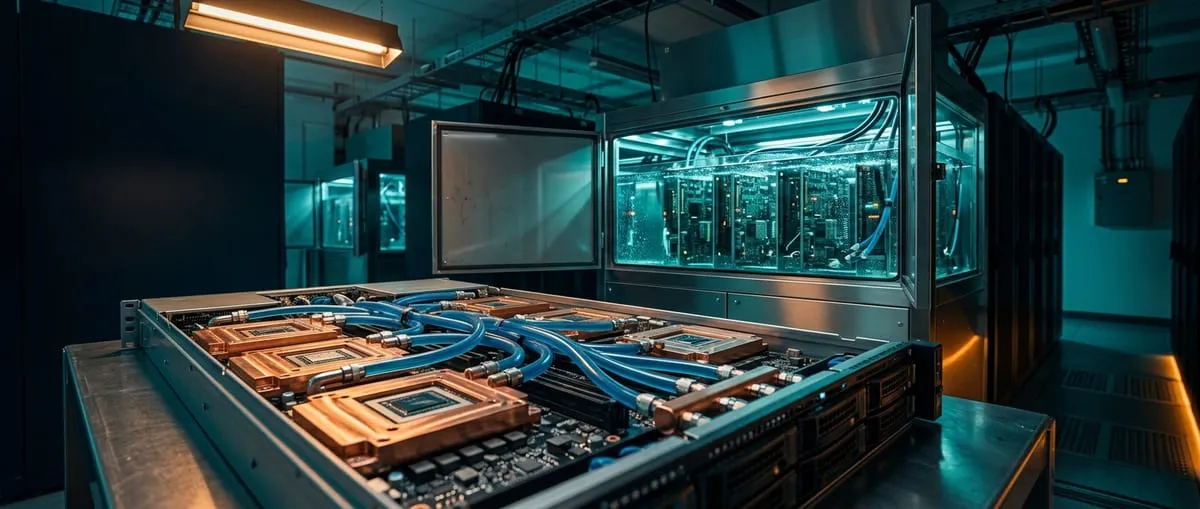
Direct-to-chip cooling fixes a metal cold plate onto each hot component, usually the GPUs and CPUs. Liquid flows through small channels in the plate and carries the heat out of the server. The Nature study describes a typical coolant of 25% propylene glycol and 75% water.
A coolant distribution unit (CDU) links the server loop to the facility water. Uptime Institute says cold plate systems can support racks above 150 kW.
Cold plates do not capture everything. The Nature study puts the liquid share at 50% to 80% or more. Uptime Institute says it can pass 90% when cold plates also cover memory and storage. Whatever the plates miss still needs room air.
That split matters for sizing. Uptime Institute gives an example: if cold plates remove 70% of a 70 kW rack, 21 kW is still left for air. Plan the room air system for that residual load.
What is immersion cooling?
Immersion cooling places whole servers in a tank of dielectric fluid, which does not conduct electricity. The fluid absorbs all of the heat, so the servers need no fans.
There are two types. In single-phase immersion, pumps move a hydrocarbon-based fluid through the tank and out to a heat exchanger. In two-phase immersion, the fluid boils at 30–50 °C on the hot chips. The vapour rises to a condenser coil, turns back to liquid and falls back into the tank.
Two-phase tanks can handle very high loads. The Nature study cites more than 500 kW per tank. But most two-phase fluids are fluorinated. The same study notes that these PFAS fluids face strict regulation proposals in the EU.
Immersion also changes how you work. ASHRAE notes that tank systems often need a crane or a two-person lift to remove servers. It also advises checking fluid compatibility and warranty terms before you deploy.
Direct to chip vs immersion cooling: which uses less energy and water?
Both save energy against air cooling, mainly because server fans shrink and chillers run less. The Nature study compared the life-cycle impact of each method with air, on the average US grid.
| Against air cooling | Cold plate | One-phase immersion | Two-phase immersion |
|---|---|---|---|
| Energy demand | −15% | −15% | −20% |
| Greenhouse gas emissions | −15% | −16% | −21% |
| Blue water consumption | −31% | −45% | −48% |
These figures use the average US grid. With 100% renewable power, the study found larger water savings of 50% (cold plate), 80% and 82% (immersion). It also found that data-centre PUE was 3% lower with cold plates and 6% lower with immersion.
Water is where liquid cooling stands out. LBNL’s 2024 report explains why: liquid systems run at higher coolant temperatures. That gives more hours of free cooling and less evaporation in cooling towers. This matters most where water is costly or limited.
Rear doors share some of this benefit. A US DOE bulletin on rear-door heat exchangers says they work well at warmer chilled-water set-points. It says they can reduce or even eliminate chiller energy.
Which is easier to retrofit and maintain?
Retrofit favours the methods that keep servers in standard racks. The US DOE bulletin says rear doors suit new and retrofit designs, and are simpler to install than a room cooling unit. Passive doors have no moving parts and need little maintenance beyond coil cleaning and water-side care.
Direct-to-chip sits in the middle. The Nature study says cold plates deploy with less disruption to air-cooled halls. But installation can be complex, and some air cooling is still needed.
ASHRAE stresses that a closed liquid loop lives or dies by its design. Its guidance includes three steps:
- Keep a list of every material the coolant touches, and approve each one.
- Use clean construction methods during installation.
- Plan how the loop will be cleaned and flushed before you build it.
Immersion is the biggest change. Racks become tanks, servicing needs lifting gear, and hydrocarbon fluids can leave oily residue around tanks, as the Nature study notes. It suits new halls built around it better than conversions.
How should you choose for your site?
Start with the heat load, not the technology. Add up the rated power of the servers in each rack. Then check which cooling band it falls in.
- Up to about 20 kW per rack: room air with good airflow is usually enough. Older rooms may manage only 10–15 kW.
- About 20–50 kW: rear-door heat exchangers extend an air-cooled room without changing the servers.
- Above about 50 kW: plan for direct-to-chip cooling, with room air for the residual heat.
- Very dense new builds: consider immersion if you can design the hall, service model and fluid choice around it.
Then weight the other factors. A bank adding one AI rack to an existing server room will value retrofit and low disruption. A new AI hall will value density and water.
Our Enterprise bundle includes liquid cooling sized for high-density racks. The Team bundle fits standard office power and cooling in most cases. For the Department bundle, our partners review rack power and cooling for sustained full load.
Networking follows the same planning. A multi-node cluster also needs a high-speed fabric between servers. Our guide to 800G Ethernet vs InfiniBand covers the fabric. For total costs, see on-prem vs cloud AI TCO.
Can you combine cooling methods?
Yes, and many sites do. ASHRAE’s 2021 white paper notes that the top-ranked supercomputers were all fully or partly liquid cooled. It describes one academic system where the CPUs are liquid cooled and the rest of each server is cooled by air through a rear-door heat exchanger.
Hybrid designs also help small sites. ASHRAE says a single liquid-cooled rack can use a liquid-to-air heat exchanger inside the rack when there is no facility water. Where facility water is available, a rack-mounted CDU can be used instead.
Watch the room air when you mix methods. ASHRAE warns that a fully loaded liquid-cooled rack can still release a lot of heat into the room. Good air management is still needed to prevent hot spots.
Key takeaways
- Room air handles about 20–25 kW per rack and rear doors about 50 kW. Cold plates handle more than 150 kW per rack, and immersion more than 150 kW per tank.
- Cold plates capture most of the heat but not all. Plan room air for the residual load.
- Against air on US grid electricity, liquid cooling cut energy by 15–20% and water by 31–48% in a 2025 Nature life-cycle study.
- Immersion saves the most water, but it is the hardest to retrofit and service. Two-phase fluids face PFAS rules.
- Weight density, efficiency, water, retrofit, upkeep and cost for your site before you choose.
Frequently asked questions
Is immersion cooling better than direct-to-chip cooling?
How much heat does direct-to-chip cooling capture?
What rack density needs liquid cooling?
Can I add liquid cooling to an existing server room?
Are two-phase immersion fluids a concern?
Sources
- Uptime Institute –AI and cooling: methods and capacities (February 2025)
- Nature (Alissa et al.) –Using life cycle assessment to drive innovation for sustainable cool clouds (Nature 641, 331–338, 2025)
- ASHRAE Technical Committee 9.9 –Emergence and Expansion of Liquid Cooling in Mainstream Data Centers (white paper, 2021)
- US DOE Federal Energy Management Program / LBNL –Data Center Rack Cooling with Rear-door Heat Exchanger (technology case-study bulletin)
- Lawrence Berkeley National Laboratory –2024 United States Data Center Energy Usage Report
- Uptime Institute –Uptime Institute Global Data Center Survey 2025